- English
- Español
- Português
- русский
- Français
- 日本語
- Deutsch
- tiếng Việt
- Italiano
- Nederlands
- ภาษาไทย
- Polski
- 한국어
- Svenska
- magyar
- Malay
- বাংলা ভাষার
- Dansk
- Suomi
- हिन्दी
- Pilipino
- Türkçe
- Gaeilge
- العربية
- Indonesia
- Norsk
- تمل
- český
- ελληνικά
- український
- Javanese
- فارسی
- தமிழ்
- తెలుగు
- नेपाली
- Burmese
- български
- ລາວ
- Latine
- Қазақша
- Euskal
- Azərbaycan
- Slovenský jazyk
- Македонски
- Lietuvos
- Eesti Keel
- Română
- Slovenski
- मराठी
- Srpski језик

What Are the Installation Requirements for Aluminum Alloy Slim Sliding Doors?
Aluminum alloy slim sliding doors are increasingly used in living rooms, balconies, kitchens, bathrooms, and interior partitions because of their clean appearance and efficient use of space. However, installing a slim sliding door is not simply a matter of bringing the finished product to the site and fixing it in place. Before installation, the opening dimensions, wall condition, track area, glass configuration, and hardware should all be checked. Proper preparation can make the installation process easier and help the door operate smoothly after installation.
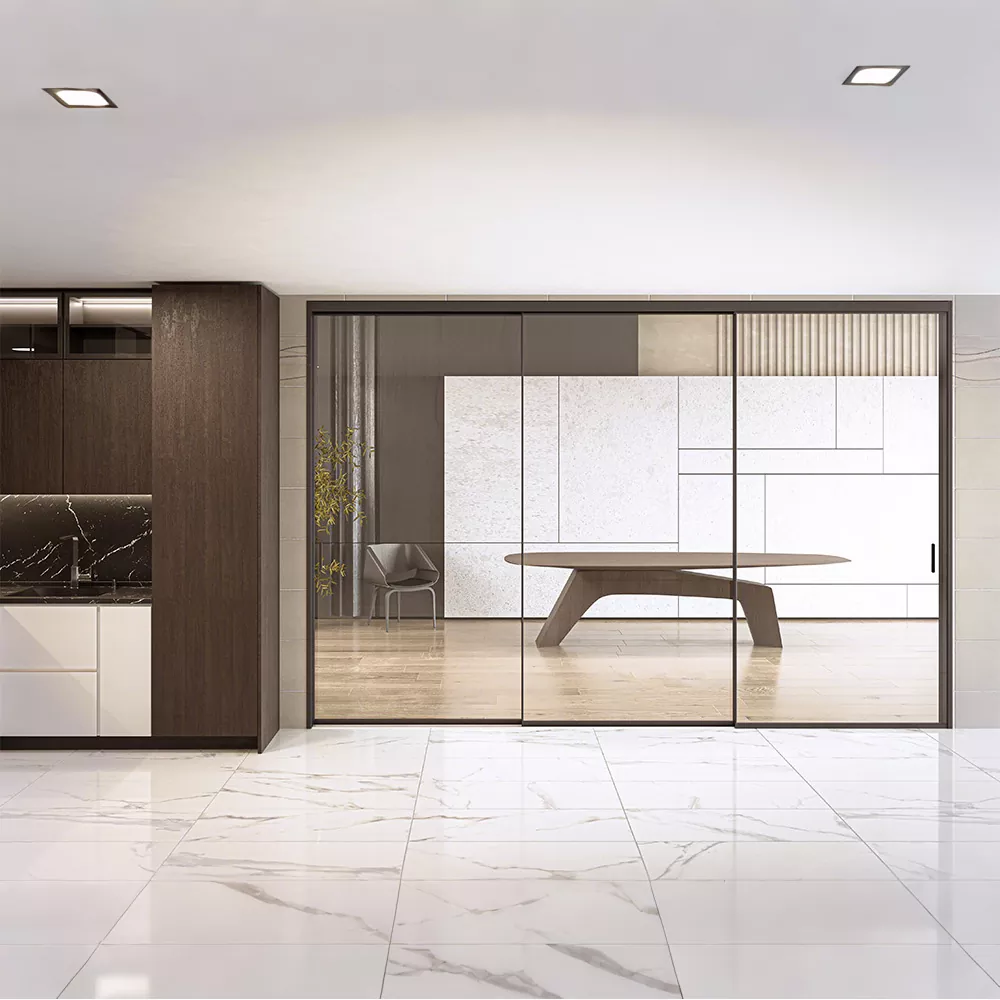
Check the Door Opening Before Installation
The first requirement is a suitable and accurately measured door opening. Before installation, check:- Whether the width and height of the opening meet the door system requirements;
- Whether both sides of the opening are reasonably straight and level;
- Whether the wall and floor provide enough space for the frame and hardware.
Choose Suitable Aluminum Alloy Profiles
Plan the Sliding Track Installation Area
The track is one of the main components affecting the daily operation of a sliding door. Before installation, the installer should check whether the floor or upper structure provides suitable conditions for the selected track system.Floor-Mounted Tracks
For a floor-mounted sliding system, the floor needs to be sufficiently level and provide the required installation space. It is also worth considering the height and shape of the track. A track that protrudes too much may affect the feeling of walking through the doorway and can make cleaning less convenient. Some slim sliding door systems use lower-profile or recessed track designs, but these require appropriate preparation and accurate installation.Top-Hung Tracks
If the sliding door uses a top-hung system, the load-bearing condition of the upper structure needs to be checked before installation. Unlike a floor-mounted system, the weight of the door is supported mainly by the upper track and its fixing structure. The installer therefore needs to make sure that the wall, ceiling, or supporting substrate is suitable for the specific door system.
Choose Glass According to the Application
Glass is another important part of an aluminum alloy sliding door. The appropriate glass configuration depends on where the door will be installed and how it will be used. For example:- Living rooms and balconies: Appearance, daylight, and the overall interior style may be important considerations.
- Kitchens and bathrooms: Privacy and resistance to the surrounding environment may receive more attention.
- Frequently used areas: Glass safety and compatibility with the door system should be considered.
Pay Attention to Rollers and Other Hardware
Sliding doors are opened and closed frequently, so rollers, tracks, handles, stops, and other hardware have a direct effect on everyday use. A properly matched sliding system should allow the door panel to move smoothly without excessive force. During product selection, it is useful to operate the door several times and check whether there is obvious resistance, shaking, or abnormal noise. The rollers should also match the weight and size of the door panel. Hardware selection should therefore be considered together with the frame and glass rather than treated as a separate detail.
Consider the Door Gap and Sealing Performance
Although sliding doors have a different structure from hinged doors, the alignment of the panels and the size of the gaps between them can still affect everyday performance. When choosing a slim sliding door, check whether the panels fit together properly and whether the gaps are reasonably controlled. An excessively large gap may affect the door's ability to reduce drafts, outside noise, or the movement of air between spaces. For this reason, making the frame as narrow as possible should not be the only design goal. The overall structure and installation accuracy are equally important.
Check the Wall and Construction Conditions
The installation environment should also be inspected before the sliding door arrives at the site. Make sure that:- The basic wall and floor work is sufficiently complete;
- There are no obvious obstacles around the installation area;
- Electrical wires and water pipes are not located in areas that will be drilled or fixed;
- The substrate around the door opening is strong enough for the planned fixing method.
Installation Starts with the Right Preparation
Installing an aluminum alloy slim sliding door requires more than selecting a door with a narrow frame. The opening dimensions, wall condition, aluminum profiles, glass, track system, rollers, and installation substrate all need to work together. Before ordering a door, it is therefore worth checking the actual installation site and confirming that the selected door system matches the available space and intended use. If you are unsure whether your installation area is suitable for an aluminum alloy slim sliding door, you can provide us with your opening dimensions, installation location, and requirements. We can help you review the conditions and recommend a suitable door configuration.Not sure which product fits your market? Tell us your target scenarios, seasons and specs. We also support custom‑made orders.