- English
- Español
- Português
- русский
- Français
- 日本語
- Deutsch
- tiếng Việt
- Italiano
- Nederlands
- ภาษาไทย
- Polski
- 한국어
- Svenska
- magyar
- Malay
- বাংলা ভাষার
- Dansk
- Suomi
- हिन्दी
- Pilipino
- Türkçe
- Gaeilge
- العربية
- Indonesia
- Norsk
- تمل
- český
- ελληνικά
- український
- Javanese
- فارسی
- தமிழ்
- తెలుగు
- नेपाली
- Burmese
- български
- ລາວ
- Latine
- Қазақша
- Euskal
- Azərbaycan
- Slovenský jazyk
- Македонски
- Lietuvos
- Eesti Keel
- Română
- Slovenski
- मराठी
- Srpski језик

Extremely Narrow Aluminum Sliding Doors in Modern Residential Design: Profile Specifications, Spatial Fitment, and Long-Term Reliability
Sliding doors are not new in residential renovation. But traditional sliding doors have one unavoidable problem: the frames are too wide. With frame widths of 5 centimeters or more, no matter how transparent the glass, there is always a visible "barrier" in front of the eyes. The reason extremely narrow sliding doors emerged is simply to compress that barrier to the point of near invisibility.
Aluminum doors are made from aluminum alloy profiles through cutting, punching, milling, tapping, assembly, and other processing steps, then assembled with connectors, sealing materials, and hardware fittings. The inherent properties of aluminum alloy—high resistance to atmospheric aging, humidity resistance, high temperature resistance, dimensional stability, non-combustibility, and corrosion resistance—provide the structural foundation for extremely narrow frame designs. Additionally, aluminum's low density and high specific strength allow narrow frames to maintain sufficient rigidity.
Extremely narrow sliding doors use ultra-narrow frames combined with minimalist track designs, with frame widths controlled between 1.5 and 2 centimeters, breaking the heavy visual feel of traditional sliding doors. Whether expanding usable space in small apartments or enhancing the sense of luxury in large flats, this door type achieves a balance between function and aesthetics through an "invisible boundary" form. This article starts from actual residential application scenarios and explains how to select extremely narrow sliding doors, which specifications in profile thickness and hardware matter, and common issues during installation and long-term use.
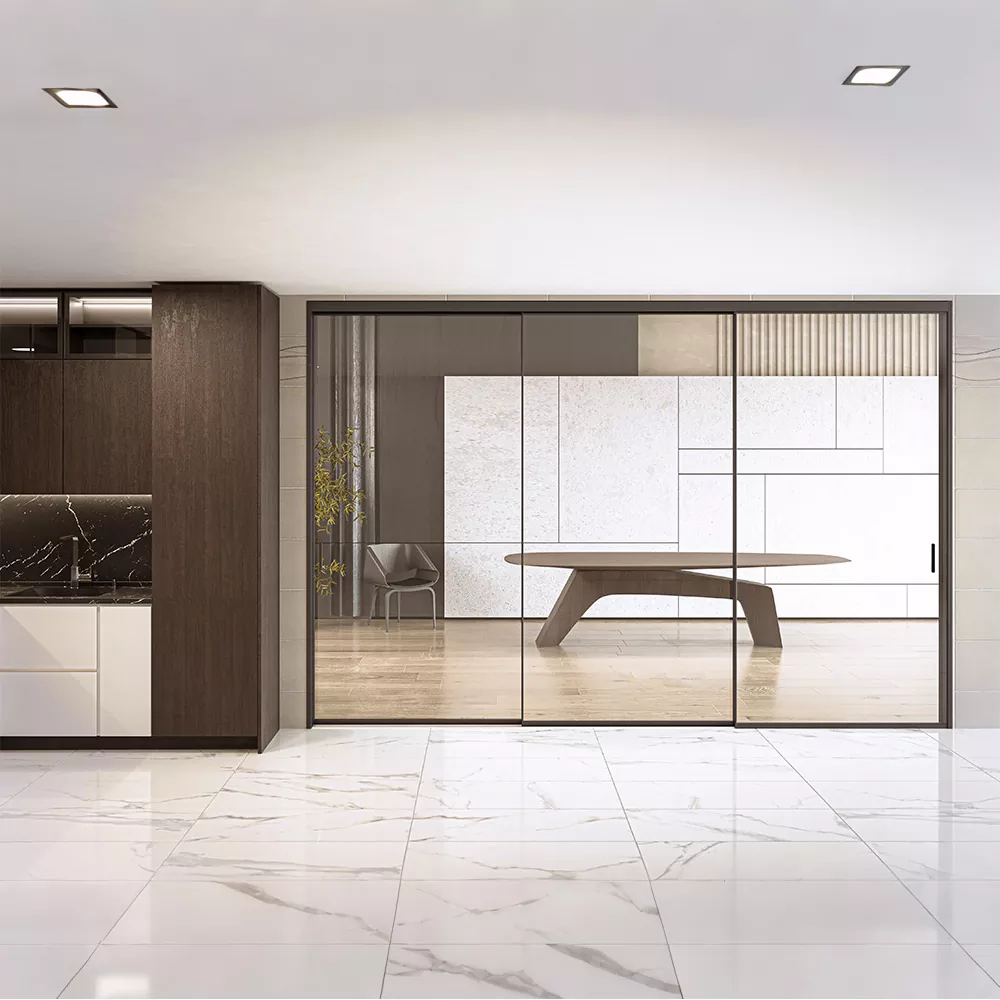
Why Extremely Narrow Sliding Doors Deserve Attention in Modern Residences
The core value of extremely narrow sliding doors cannot be summarized simply as "the door frame got narrower." What it changes is how spaces are divided—using a visually almost non-existent boundary to achieve flexible functional opening and closing.
Impact on Spatial Perception and Natural Light
Traditional sliding doors typically have frame widths between 5 and 8 centimeters. Add tracks and door casings, and the actual visual obstruction is even greater. For a 2-meter-wide door opening, the frame obstruction area of a traditional sliding door accounts for approximately 15% to 20% of the total opening area. Extremely narrow sliding doors compress the frame to 1.5 to 2 centimeters, reducing the obstructed area to about 5%. The difference of 15 percentage points represents a qualitative change in visual experience—from "there is a barrier" to "the barrier is almost invisible."
The impact on natural light is equally significant. Narrower frames mean a larger glass-to-frame ratio, with less natural light lost passing through the door opening. In areas requiring shared daylight—such as between a balcony and living room, or between a kitchen and dining room—extremely narrow sliding doors can achieve spatial separation without sacrificing light.
Typical Applications Across Different Residential Scenarios
Small apartment space expansion: In homes with limited floor area, every centimeter of space should not be wasted on door frames. Extremely narrow sliding doors slide along the wall with minimal track footprint, suitable for narrow hallways, kitchen openings, balcony entrances, and similar areas. Traditional hinged doors require a swing radius, while sliding doors only need lateral space beside the opening—for space-constrained areas like kitchens and balconies, this difference is very significant.
Open kitchen partitions: The pain point of open kitchens is cooking odor and grease diffusion. Fully enclosed kitchen doors make the space feel cramped. Extremely narrow sliding doors offer a compromise: kept open daily for an unobstructed feel, closed during heavy cooking to contain grease and odors. Because the frame is extremely narrow, even when closed, visibility through the glass remains, avoiding the oppressive feeling of "closing off the kitchen."
Living room-balcony integration: Connecting the balcony and living room has been a trend in recent renovations. But complete integration means losing the balcony's flexibility as an independent functional area. Extremely narrow sliding doors here serve as a "divisible yet connectable" solution—open most of the time to form a continuous large space, closed when drying laundry or blocking outside noise. Light passes through the large glass area into the living room without obstruction from wide frames.
Minimalist interior styles: Modern, light luxury, wabi-sabi, and similar styles share a common characteristic: reducing unnecessary decorative elements. The design logic of extremely narrow sliding doors aligns perfectly with these styles—minimizing the door's visual presence and letting the space itself become the protagonist.
Key Specifications of Extremely Narrow Sliding Doors
A qualified extremely narrow sliding door is defined by several hard parameters, not simply by how narrow the frame appears.
Profile Material, Wall Thickness, and Surface Finish
The main technical specifications of aluminum sliding doors are summarized below:
| Parameter | Typical Value | Note |
|---|---|---|
| Frame width | 1.5 – 2 cm | Core dimension for narrow series |
| Profile wall thickness | 1.8 – 2.5 mm | Load-bearing structures should be ≥2.0 mm |
| Aluminum alloy grade | 6063-T5 / 6061-T6 | Common grades for architectural doors/windows |
| Surface finish | Anodized / Powder coated / Wood grain transfer | Determines weather and corrosion resistance |
| Glass configuration | 5+20A+5 tempered insulated glass | Baseline for sound and thermal insulation |
| Single panel load capacity | 80 – 120 kg | Depends on rollers and profile specification |
| Track type | Concealed bottom track / Top-hung | Floor track or ceiling suspension |
The table shows that frame width is just the tip of the iceberg. What truly determines whether a door will perform reliably over the long term are wall thickness and hardware quality. A 1.5 cm narrow frame looks impressive, but if wall thickness is insufficient, the door panel will wobble or deform with repeated use. For a qualified extremely narrow sliding door, load-bearing frame walls should be at least 2.0 mm thick, with non-load-bearing parts no less than 1.4 mm.
Aluminum Material Properties and Durability
6063-T5 aluminum alloy is the most commonly used material in architectural doors and windows. Its tensile strength ranges from 150 to 180 MPa, with elongation above 8%—sufficient for residential sliding door applications. The higher-grade 6061-T6 offers tensile strength above 260 MPa, but this is over-specification for ordinary residential doors.
The natural corrosion resistance of aluminum comes from its self-forming oxide layer. However, this natural layer is thin (typically less than 5 microns) and insufficient in humid or coastal environments. Therefore, industrial processes such as anodizing or powder coating are applied. Anodizing can thicken the oxide layer to 10-25 microns, while powder coating can reach 40-80 microns. For coastal areas or humid environments such as basements and bathrooms, powder-coated surfaces are recommended.
Roller System and Sliding Feel
The core hardware of a sliding door is the roller system. Extremely narrow sliding doors typically have rollers hidden at the bottom or top edge of the door panel, invisible from the outside. The roller material, bearing type, and track compatibility directly determine whether sliding is smooth and silent.
Quality rollers use stainless steel bearings with nylon or rubber outer rings, producing almost no metal friction noise during sliding. Low-end rollers use steel ball bearings or even bearing-less plastic wheels, which become stiff and noisy after a few months of use.
Regarding track types, extremely narrow sliding doors come in two forms: bottom track and top-hung. Bottom tracks are simpler to install and more reliable for load bearing, but the track channel tends to collect dust. Top-hung tracks have no floor track, making cleaning easier, but they require higher installation precision and adequate wall load-bearing capacity.
Sealing, Sound Insulation, and Thermal Performance
The aesthetic advantage of extremely narrow frames comes with a trade-off in sealing performance—the narrower the frame, the fewer sealing strips can be accommodated. Qualified extremely narrow sliding doors use EPDM (ethylene propylene diene monomer) sealing strips at door panel overlaps and frame-wall junctions. This material resists aging, maintains elasticity, and performs consistently across temperatures from -40°C to 120°C.
The standard insulated glass configuration is 5+20A+5—two 5 mm glass panes with a 20 mm air gap. This is the baseline for residential sliding doors, providing sound reduction of approximately 30-35 decibels and better thermal performance than single-pane glass.
Selection and Residential Fitment
Choosing Number of Panels by Opening Width
- Opening width 1.2 – 1.5 meters: Two panels (one fixed, one sliding) or two-panel center-sliding
- Opening width 1.5 – 2.4 meters: Three or four panels, allowing larger opening clearance
- Opening width above 2.4 meters: Four or more panels, or multi-track systems
It should be noted that the single-panel width of an extremely narrow sliding door generally should not exceed 1.2 meters. Excessively wide panels increase demands on profile rigidity and roller load capacity exponentially, leading to higher failure rates.
Choosing Track Type by Use Scenario
- Balcony doors: Bottom track recommended. The height difference between balcony and living room allows the bottom track to also serve water stopping and sealing functions. Choose ultra-low copper or stainless steel tracks with height 5 mm or less to reduce tripping risk.
- Kitchen doors: Both bottom track and top-hung options work. If the kitchen floor has underfloor heating, top-hung tracks are not recommended (drilling may damage heating pipes).
- Walk-in closets / home offices: Top-hung tracks are more suitable. No floor track means a cleaner visual appearance and easier cleaning of carpets or flooring underneath.
Common Issues During Installation and Long-Term Use
In actual residential use, the following issues occur most frequently:
- Sticking or noisy sliding: In 90% of cases, this is caused by dust accumulation in the rollers or debris in the track. Clean the track channel regularly with a vacuum cleaner and apply lubricating oil to roller bearings annually. If the rollers themselves are worn, they need replacement.
- Door panel wobbling: Usually due to insufficient profile wall thickness or loose connectors. Check whether the bolts connecting the panel to the rollers are tight. If the profile itself lacks rigidity, the panel must be replaced.
- Poor sealing / air leakage: This is an inherent limitation of extremely narrow frames. If sealing performance is a high priority (for example, in street-facing homes requiring sound insulation), consider frames that are slightly wider (2.5-3 cm) but equipped with more comprehensive sealing strips. Extremely narrow aesthetics should not come at the cost of basic functionality.
- Fogging between glass panes: Indicates failure of the insulated glass unit seal, allowing moisture-laden air to enter the gap. Contact the supplier for glass unit replacement under warranty. This issue relates to glass processing quality, not the door frame itself.
Manufacturing Processes and Quality Control
The manufacturing process for aluminum doors includes profile cutting, punching, milling, tapping, assembly, followed by final assembly using connectors, sealing materials, and hardware. The most precision-critical steps are 45-degree corner cutting and corner joint assembly—extremely narrow frames are very sensitive to joint gaps. A 0.5 mm error is barely noticeable on a 5 cm wide frame, but it becomes very obvious on a 1.5 cm wide extremely narrow frame.
In quality control, qualified suppliers use CNC double-head cutting saws and corner crimping machines to ensure cutting angles and joint precision. Profile wall thickness can be spot-checked with a caliper. Surface finish quality can be verified through cross-cut adhesion tests and salt spray corrosion tests.
Cost and Overall Value
In the cost structure of extremely narrow sliding doors, profiles account for approximately 30%, glass 20%, hardware 25%, and manufacturing plus installation labor 25%. Compared to traditional sliding doors, extremely narrow sliding doors typically cost 30% to 60% more, with the premium coming from more refined profile cross-section designs, higher precision machining requirements, and brand positioning.
Whether this premium is justified depends on the style positioning of the renovation and the specific spatial conditions. For projects pursuing minimalist, modern, or light luxury aesthetics, the visual improvement brought by narrow frames cannot be achieved with traditional sliding doors. For budget-limited projects or those where door appearance is not a priority, traditional sliding doors remain the more pragmatic choice.
Key Takeaways
- The core selection parameters for an extremely narrow sliding door are: frame width, profile wall thickness, roller quality, track type, and sealing design.
- A frame width of 1.5-2 cm is key to visual effect, but wall thickness cannot fall below 2.0 mm (on load-bearing parts)—otherwise the door panel will wobble.
- The weather and corrosion resistance of aluminum doors comes from both the material itself and surface finishing. In coastal or humid areas, powder coating is recommended.
- Sticking and noise during sliding are most often caused by dirty or worn rollers. Regular cleaning and lubrication resolve most issues.
- Extremely narrow frames offer clear aesthetic advantages but may compromise sealing performance. Trade-offs must be considered based on actual sound insulation requirements.
Frequently Asked Questions
Can extremely narrow sliding doors be used in bathrooms?
Yes, with two considerations: first, aluminum itself is moisture-resistant, but rollers and hardware must be stainless steel; second, bathroom doors require privacy, so frosted or switchable privacy glass should be used.
Are extremely narrow sliding doors strong enough?
A qualified product has a single-panel load capacity of 80-120 kg, sufficient for 5+20A+5 insulated glass units. Larger-than-standard door panels require custom-reinforced profiles.
Which is more durable: bottom track or top-hung?
Bottom tracks are more durable because the door panel weight rests on the floor track and rollers, while the top track and wall anchors serve only as guides. In top-hung systems, the entire weight is carried by wall anchors via the top track bolts, requiring higher installation precision and wall strength.
How effective is the sealing on extremely narrow sliding doors?
Less effective than hinged doors and less effective than wider-frame sliding doors. Extremely narrow frames have limited space for sealing strips. If sound insulation and thermal performance are top priorities, extremely narrow aesthetics should not be pursued at the expense of sealing.
How can I check aluminum profile quality?
Use a caliper to measure wall thickness against specifications. Inspect the cross-section for dark spots or impurities. Check whether the surface finish is uniform and smooth. Request material certificates and test reports from the supplier.